Most people who buy their first dumbbells make the same mistake, and it is not about the exercises. It is the weight. They pick whatever feels manageable in the shop, get home, and either cannot finish a set or find it too easy to bother. Either way, the dumbbells end up in a corner within a few weeks.
Using dumbbells well comes down to three things: choosing the right weight, using correct form from the first session, and following a routine that fits the time and space you have. Get those right and dumbbells usually become the most-used equipment in a home gym, which is why they are almost always the first purchase when people plan how to build a home gym.
How to choose the right dumbbell weight
The right weight is not the heaviest one you can lift once. It is the weight you can lift with good form, for the number of reps you are aiming for, session after session. There is no single right number, because it depends on the exercise and your experience, but there is a simple test.
The 12–15 rep test
Pick a weight and do one set of 12–15 reps of an exercise:
- If you cannot get past 8 reps with control, it is too heavy.
- If you finish 15 reps and it felt easy, it is too light.
- If the last 2–3 reps are hard but your form stays the same, you are in the right range.
Starting weights for beginners
| Type of exercise | Examples | Typical starting weight (per dumbbell) |
|---|---|---|
| Single-joint arm and shoulder moves | Curls, lateral raises | 2–5 kg |
| Pressing moves | Shoulder press, chest press | 4–8 kg |
| Leg and full-body moves | Goblet squats, lunges | 6–12 kg |
These numbers vary a lot from person to person, so treat them as a starting point, not a rule. Recheck every few weeks: once you can complete all your sets and reps with good form for two sessions in a row, move up a step.
Signs the weight is too heavy
- You have to swing or jerk the weight to start the movement
- Your wrists bend back instead of staying straight
- You lean back or arch your lower back during arm or shoulder exercises
- You need long pauses in the middle of a set
If any of these sound familiar, drop down a step and build back up.
Light and heavy dumbbells both have a place
Lighter dumbbells are useful for learning a new movement, for high-rep sets and for warm-up sets. Heavier dumbbells are for lower-rep sets once your form is steady. That is why many home buyers choose adjustable dumbbells: one pair covers light and heavy without buying five separate pairs.
Which dumbbells to buy for home
You have two main options:
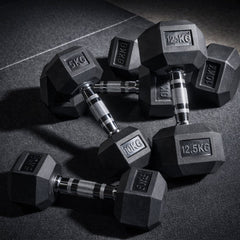
- Fixed-weight sets are simple and quick to pick up. Our dumbbell sets come in 15, 20, 30 and 50 kg (from 15.45 KD to 44.95 KD). The 15 kg set is a common first buy.
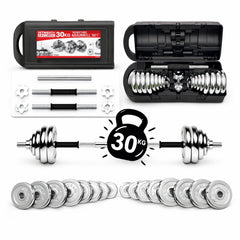
- Adjustable dumbbells change weight in steps, so one pair replaces several and saves space in an apartment. The 24 kg adjustable dumbbell set adjusts from 2.5 kg to 24 kg and costs 44.95 KD.
If you also want a barbell or kettlebell, the adjustable dumbbell, barbell and kettlebell in one starts at 52.45 KD. Whatever you choose, check:
- Coating and grip: rubber-coated dumbbells are kinder to tiled floors, and bare metal needs wiping in humid, air-conditioned rooms to prevent rust
- Weight steps: smaller steps between settings make it easier to move up gradually
- Locking mechanism: on adjustable sets, make sure the plates lock firmly before every set, especially for overhead presses
- Storage: a dumbbell rack keeps weights off the floor and out of the way
You can compare all sets, racks and benches in our gym equipment collection, or try the weights in person at our Shuwaikh showroom.
Form basics for every exercise
Free weights have no fixed path like a machine, so how you move matters. A few habits cover most of it:
- Keep your wrists straight, in line with your forearm, especially on presses and curls
- Control the tempo: lower the weight over two to three seconds instead of letting it drop
- Use the full range of the movement rather than short, partial reps
- Breathe with the movement: breathe out on the effort, in on the return
- Work both sides evenly: if one side finds a weight much harder, stay at that weight rather than adding more
Six core dumbbell exercises for home
Goblet squat: hold one dumbbell at chest height and squat as if sitting back into a chair. Keep the weight close to your chest and your torso upright rather than leaning forward.
Bent-over row: hinge at the hips with a flat back and pull the dumbbells toward your ribs, not your shoulders.
Shoulder press: seated or standing, press the dumbbells overhead without arching your lower back. If you have to arch to finish the rep, the weight is too heavy.
Chest press: lie on the floor or a flat bench and press the dumbbells up. On the floor, lower only until your elbows touch the floor.
Bicep curl: keep your elbows by your sides and lift slowly. Swinging your body to lift the weight is the most common mistake.
Romanian deadlift: with a slight bend in the knees, hinge at the hips and let the dumbbells slide down the front of your legs, keeping your back flat. Start light until the movement feels natural.
If you want to add a bench for presses and rows, the adjustable gym bench with bar is 35 KD.
A simple routine to start with

- Two to three sessions a week, with a rest day in between
- Full-body sessions using the six exercises above, which suits most home schedules
- 8–10 sets in total per session, changing reps and weight rather than adding new exercises
- Add pulling work: pair dumbbells with pull-up bar exercises if you have a bar
Keep it simple. A routine that is easy to remember is easy to repeat.
Warming up
- A few minutes of easy movement, such as marching on the spot or a short walk
- Arm circles, hip circles and a few bodyweight squats
- One lighter set of your first exercise before your working sets
Common mistakes with dumbbells
- Starting too heavy. If your form breaks by rep four, the weight is too heavy for now.
- Swinging the weight. Lift under control; a rep done with momentum is not doing its job.
- Skipping the warm-up set. Going straight to your working weight is the easiest way to get a rep wrong.
- Never changing the weight. A weight that felt hard in week one may feel easy by week four, so recheck regularly.
- Copying someone else's weight. What a friend lifts tells you nothing about your own starting point.
- Leaving dumbbells on the floor. Tripping over weights is a real risk at home; use a rack or a fixed spot.
Buy dumbbells in Kuwait with Bab Al-Saif

Not sure which set suits you? Visit our showroom at Shuwaikh Plaza, Khalifa Al-Jassim Street, Shuwaikh Industrial, and try the weights before you buy. We have been in Kuwait since 1992 and are rated 4.7★ from over 350 Google reviews. Pay cash on delivery, by card, or with Deema instalments, with delivery across Kuwait. Or simply contact us and we will help you pick a first set.
FAQs
What weight dumbbells should a beginner start with?
It depends on the exercise. Many beginners start around 2–5 kg for arm exercises, 4–8 kg for presses and 6–12 kg for squats and lunges, then adjust using the 12–15 rep test.
How do I know if my dumbbells are too light?
If you can easily do more than 15 reps and the last few do not feel hard, it is time to move up a step.
Should I buy fixed or adjustable dumbbells?
For most homes, adjustable dumbbells are more practical: one pair covers a wide weight range and takes less space. Fixed sets are simpler and quicker if you only need a few weights.
How often should I increase the weight?
A common guideline is to move up once you can complete all your sets and reps with good form for two sessions in a row.