A treadmill looks simple: step on, pick a speed, start walking. That simplicity is why many people use one for months without ever thinking about setup, speed, incline or safety. In Kuwait a treadmill is often the only practical way to walk or run regularly for much of the year, so it is worth using it properly.
This guide covers placing and setting up the machine, using it safely, a few workouts to try, how to fit it around weight training, and what to check before you buy. It is one of the questions our team hears most from first-time buyers: not which treadmill to get, but how to use it well once it is home.
Why a treadmill makes sense in Kuwait
Outdoor walking and running work for perhaps four or five months of the year, and even then only early in the morning or late in the evening. The rest of the year, an indoor machine is the more realistic option:
- You do not have to plan around the heat or the forecast
- Dust and sandstorms do not cancel your session
- You walk on an even, predictable surface instead of uneven pavements
- You can fit a session in at any hour, even late at night
Where to put your treadmill
- Leave clear space behind it: about 2 metres behind the belt and at least 50 cm on each side, so nothing is in the way if you step off the back
- Use a flat, level floor: an uneven floor makes the machine rock and wears the belt unevenly
- Keep it in an air-conditioned room and out of direct sun, which is kinder to the motor and the display
- Plug it straight into a wall socket rather than a cheap extension lead, and keep the cable out of the walking path
- Keep children and pets away while it is running, and remove the safety key when you finish
Setting up before every session
- Clip the safety key to your clothing. If you slip or step back, the key pulls out and the belt stops. It is the most overlooked safety habit.
- Stand on the side rails, not the belt, when you start, and step on once the belt is moving slowly.
- Start slowly and increase speed gradually after a few minutes.
- Wear proper trainers, not socks, sandals or bare feet.
Speed, incline and form
- Keep a natural stride. If you are reaching forward with your front foot to keep up, the belt is too fast for you.
- Stay in the middle of the belt, not near the front of the motor cover or the back edge.
- Look ahead, not down at your feet. It is easier to stay centred on the belt.
- Use the handrails for getting on and off and for balance if you need it. If you find you have to hold on tightly to keep up, slow the belt down.
- Use incline gradually. A small incline of about 1% is a common setting for running indoors. Raise it in small steps, and lower the speed when you raise the incline.
- Slow down before you stop. Walk for a couple of minutes at an easy pace, then stop the belt completely before stepping off.
Treadmill workouts to try
- Steady walk or jog: the same comfortable pace for 20–30 minutes. The best place to start if you are new to the machine.
- Incline walk: a brisk walk with the incline raised in small steps. Walk; do not run on steep settings.
- Intervals: alternate one to two minutes at a faster pace with the same time at an easy pace, for 20–30 minutes. Try this once you are comfortable with the machine.
- Progressive pace: start slowly and raise the speed a little every five minutes, to learn what pace you can keep up.
Change only one thing at a time: speed, incline or session length. Increase gradually from week to week rather than all at once.
Treadmill before or after weights?
If your home gym has dumbbells too, you may wonder which to do first. There is no single right answer, but a simple plan works for most people:
- Before weights: a few minutes of easy walking is a common way to start a session.
- A longer treadmill session: many people do it after the weights, or on a different day, so they are not tired while handling dumbbells, when careful form matters most.
- Pick the order by what matters most to you that day, and keep it consistent from week to week.
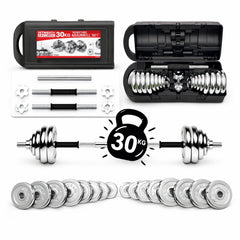
For the weights side of the session, see our guide on how to use dumbbells.
Common mistakes on a treadmill
- Not clipping on the safety key. It takes two seconds and stops the belt if you slip.
- Stepping onto a fast belt. Always start slowly from the side rails.
- Jumping off while the belt is moving. Slow down, stop, then step off.
- Increasing speed too quickly. Build up over several sessions.
- Too little space behind the machine. A wall or furniture close behind the belt is a real hazard.
- Skipping maintenance. Unplug the machine before cleaning, keep the belt and deck free of dust, and follow the manual for belt tension and lubrication.
What to check before buying
- Walking or running: a walking pad is compact and designed for walking; a full treadmill with a larger motor suits jogging and running.
- Belt size: a longer, wider running surface gives you more room to move.
- Maximum user weight: check it is comfortably above the heaviest person who will use it.
- Folding and storage: in an apartment, a foldable machine or a walking pad that slides under a sofa or bed saves a lot of space.
- Local service and parts: belts and motors eventually need attention, so buy from someone you can reach in Kuwait.
Our full-size treadmills are out of stock at the moment, so ask us about availability. In stock now, the walking pad treadmill (52.45 KD) is a compact option for walking up to 6 km/h, for users up to 100 kg. If you would rather sit, exercise bikes such as the foldable exercise bike with desk (42 KD) and the indoor spinning bike (45 KD) are also available. See everything in our cardio machines collection, and if you are planning a whole room, read how to build a home gym in Kuwait.
See it before you buy

Visit our showroom at Shuwaikh Plaza, Khalifa Al-Jassim Street, Shuwaikh Industrial, to see the machines in person. Bab Al-Saif has been in Kuwait since 1992 and is rated 4.7★ from over 350 Google reviews. Pay cash on delivery, by card, or with Deema instalments, with delivery across Kuwait. To check treadmill availability, contact us.
FAQs
What incline should I use on a treadmill?
Many people use about 1% for running indoors. For walking, raise the incline in small steps and slow the speed down when you do.
Is it OK to hold the handrails?
Use them to get on and off and for balance. If you have to grip them to keep up, the belt is too fast: slow it down.
How long should a treadmill session be?
Start with 20–30 minutes at a comfortable pace and build up gradually, changing one setting at a time.
What is the difference between a walking pad and a treadmill?
A walking pad is a compact, low machine designed for walking, and it stores easily. A full treadmill usually has a larger belt, handrails and a stronger motor for jogging and running.