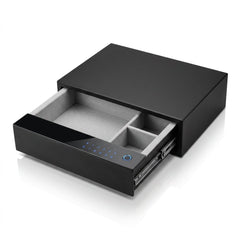
Four electronic safes are listed on this site, and they do not all give you the same way back in: two record a mechanical override key, one records a USB emergency power port, and two record no backup at all. If your safe will not open, read the model name off it, find it in the table below, and check which of those two routes you actually have before you try anything else.
This page is about a safe that has stopped opening. If the keypad still works and you only want to change the code, our step-by-step guide to resetting an electronic safe code covers that job instead.
Five checks, in this order
The one thing people get wrong is going straight for the keypad. Three of the four state a battery or a set of cells as their power source, and the fourth states none at all, so on most of them the question is a power question before it is a keypad question.
- Read the model name off the safe, or off its box, and find the matching row in the table below. The four listings differ from each other on every line that matters here.
- Find out what powers your model. Two of the four run on AA cells, one runs on a rechargeable lithium battery, and one listing states no power source at all.
- If your model takes AA cells, change them for a fresh set before anything else. On the 460 x 410 x 155 mm drawer safe the cells are not supplied in the box, so the set in it now is a set you bought.
- If your model records an emergency power port, put power into that port. The smart safe drawer is the only one of the four whose listing states an emergency power option, through its Type-C or Micro-USB port. The three-drawer locker has a Type-C port too, but its listing calls that the charging method for its own battery, not an emergency route, and those are not the same claim.
- If your model records a mechanical key, use it. If it records neither a key nor an emergency port, stop there. Do not drill, lever or force the door: bring the unit to the counter at Shuwaikh Plaza, Khalifa Al-Jassim Street, Shuwaikh Industrial, or contact us first.
What backup does each safe actually have?
This is the whole page in one table. Every cell is read from the product listing or its specification field, and an empty cell means the listing states nothing, not that the answer is no.
| Safe | Ways in | Backup if the power dies | Power | Fingerprints | Codes | From |
|---|---|---|---|---|---|---|
| Smart safe drawer, 48 to 87 cm | Fingerprint, 4 to 6 digit code, mechanical override key | 2 mechanical keys in the box, plus Type-C or Micro-USB emergency power | 4 x AA cells | 40 | 10 | 39.950 KD |
| Digital fingerprint drawer safe, 460 x 410 x 155 mm | Fingerprint, backlit touch keypad | Listing states none | AA cells, not supplied | 40 | 10 | 109.950 KD |
| Smart safe locker, 1 to 3 drawers | Fingerprint, code, key, Bluetooth, phone | Key unlock is listed as a method, but no key is listed in the box | Rechargeable lithium, Type-C charging | 100 | 1 | 89.950 KD |
| Electronic safe locker, 9 kg | Fingerprint, code | Listing states none | Listing states none | 30 | Listing states none | 22.000 KD |
Read the third row carefully. The listing for the drawer locker names key unlock among its five ways in, and it does not list a key among the things in the box. Those are two different facts and only one of them helps you at the point where you are standing in front of a locker that will not open.
The one safe that stores only one code
The three-drawer locker stores up to 100 fingerprints and, according to the same specification field, exactly one password. The other three store 10 code sets each, or state nothing. If several people need their own code rather than their own fingerprint, that single figure is the line that decides which of the four you want.
What none of these four listings tells you
We will not print a reset sequence, because not one of the four listings contains one. That matters more than it sounds: a reset sequence is brand and model specific, and a wrong one entered repeatedly is read by many keypads as an attack rather than a mistake. Specifically, none of the four records:
- the button sequence to clear or set a code
- how to enrol or delete a fingerprint
- what the unit does after a run of wrong entries, or how long any lockout lasts
- how long a set of cells lasts, or what a low-power warning looks like
- the factory code it ships with
Only one of the four, the smart safe drawer, lists an installation manual among its box contents. For the other three, the printed sheet in the box is the only place that sequence exists, which is the practical argument for keeping it taped inside a cupboard rather than in the safe.
Prices, and what the extra money buys
The smart safe drawer is sold in four widths, and its ladder runs in order: 48 cm at 39.950 KD, 67 cm at 55.000 KD, 77 cm at 65.000 KD and 87 cm at 77.000 KD, all 40 cm deep and 15 cm tall. Its specification field states, in bold, that the front panel is not included, so it is made to be built into furniture you already have rather than stood on a floor.
The drawer locker runs 89.950 KD for one drawer, 119.950 KD for two and 159.950 KD for three, with the listing giving drawer weights of 10, 15 and 19 kg. All three measure 35 cm wide and 40 cm deep, so the only dimension that changes is height: 15, 24 and 33 cm.
The 9 kg electronic safe locker at 22.000 KD is the only one of the four with a stated external size of H250 x W350 x D280 mm and a metal body, and it is the only one that is not a drawer. Browse all five listings in the digital safes and cabinet collection, which also holds a bedside table with a fingerprint-locked compartment.
Fitting one in a Kuwait flat or villa
Three of the four are drawer units, and a drawer unit has to be screwed to something. The smart safe drawer's listing states it is fixed with screws, and with no front panel supplied it expects a cabinet, a reception counter or a wardrobe carcass around it. In a rented apartment that is worth checking against your tenancy before you drill, and in a majlis or a villa fit-out it is usually easier to have the joiner do it while the cabinetry is still open.
The 9 kg unit is the exception: it is a free-standing box, and 9 kg is the net weight its own listing states.
FAQs
Which safe locker has a backup key?
Of the four listed here, the smart safe drawer is the one that states two mechanical keys in the box. The drawer locker lists key unlock as a method without listing a key as an accessory, and the other two record no key at all.
Can I open a safe drawer if the battery is flat?
Only if your model records a route for it. The smart safe drawer states an emergency power option through its Type-C or Micro-USB port as well as its two keys. The 460 x 410 x 155 mm drawer safe and the 9 kg locker state nothing, so on those two a flat set of cells is a trip to the counter.
What powers an electronic safe?
Among these four: 4 x AA cells on the smart safe drawer, AA cells not supplied on the 460 mm drawer safe, a rechargeable lithium battery charged over Type-C on the drawer locker, and nothing stated on the 9 kg locker.
How many fingerprints can a home safe store?
These four store 40, 40, 100 and 30. The 100 figure is the three-drawer locker, which is also the one that stores only a single password.
What does a safe box cost in Kuwait?
The four here start at 22.000 KD for the 9 kg locker and 39.950 KD for the smallest smart safe drawer, and reach 159.950 KD for the three-drawer unit. All prices are the lowest listed option for each product.
Is there a safe that is not obviously a safe?
The drawer units are made for it. The 460 x 410 x 155 mm model is described in its own listing as fitting inside existing furniture and pulling out like an ordinary drawer, and the smart safe drawer ships without a front panel so that your own cabinet front becomes its face.
If your safe is open but the code is the problem, start with our guide to resetting an electronic safe code. If it is shut and nothing works, contact us with the model name and we will tell you what that listing says is in the box.